
Change Log 7/8/2026
More accurate data , AI Spillover and 4 Legends make better investment decisions.

👋 Hey there, I’m Weng. Each week, I tackle reader questions about AI stock analysis, investing tools, and building wealth without the hype. For more:
AI Agent& Skills | Portfolio Reveal | Premium
Fix 1 : Ai spill over Map
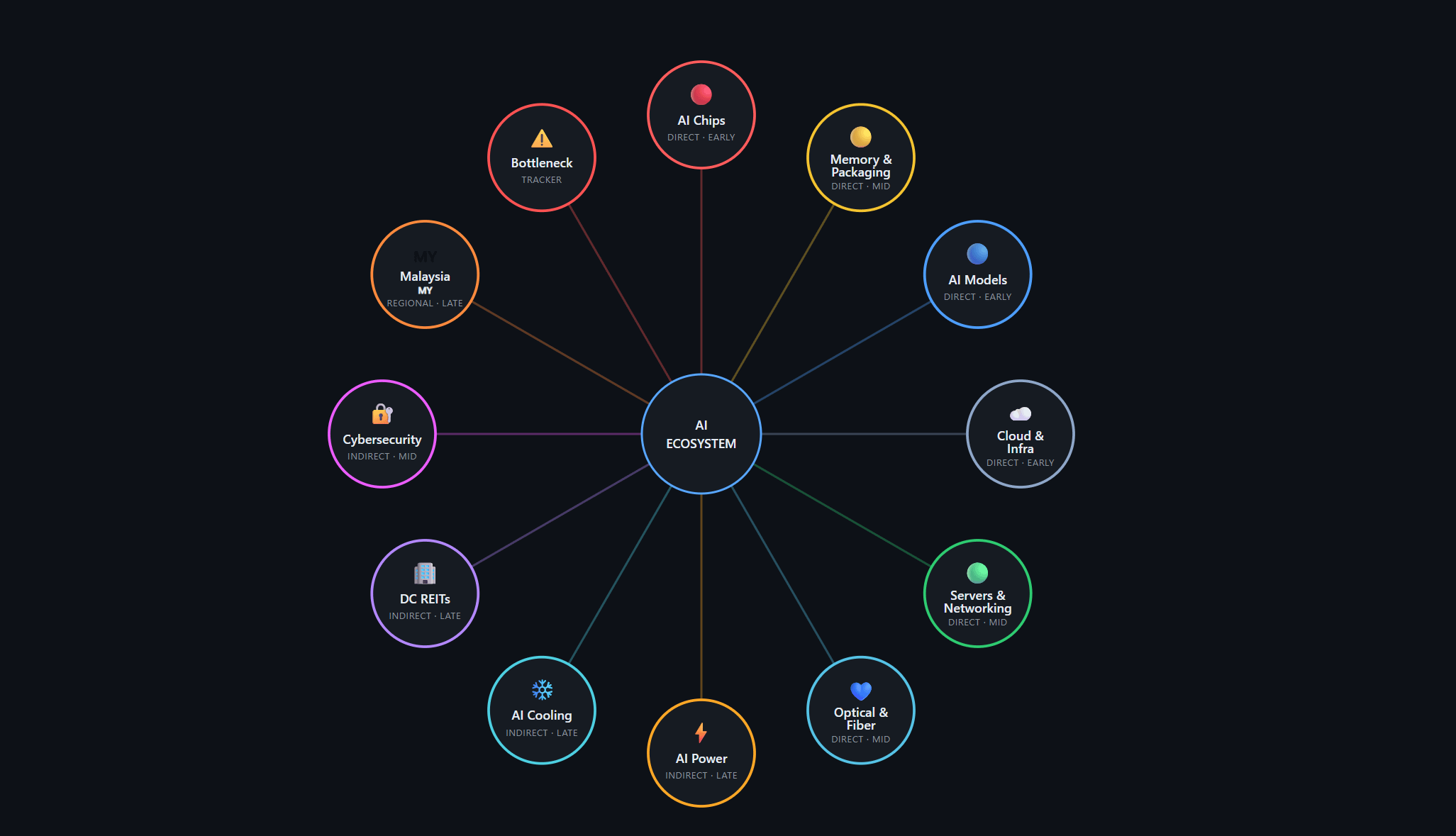
What’s inside ai-spillover-map
It packs three things: (1) instructions/rules, (2) an embedded “stock universe” of ~110 tickers grouped into 11 sectors + a Bottleneck node, and (3) a full dark-theme HTML/SVG template with the rendering JavaScript baked in.
When triggered (”generate AI spillover map”, “refresh the AI map”, etc.), it runs a 4-step workflow:
Fetch every price live via web search at trigger time — the embedded prices are treated as stale placeholders and never reused. Each price must pass three checks before earning a ✓ badge: split/reverse-split check, market-cap sanity gate (price × shares ≈ market cap), and 52-week range plausibility. Anything it can’t confirm gets a visible
⚠ UNVERIFIEDtag.Assemble branch data — apply fresh prices/targets, compute upside %.
Build & save the HTML — a radial mind map with 12 ring nodes (11 sectors: chips, memory/packaging, models, cloud, servers, optical, power, cooling, DC REITs, cybersecurity, Malaysia/Bursa — plus a Bottleneck Tracker node), a timestamp line, and a financial disclaimer.
Present the file with the fetch timestamp and usage notes.
What problem it solves
It turns weeks of “who benefits across the whole AI supply chain, and what do they cost right now” into one shareable, always-current visual. It maps the full value chain (direct chips → indirect power/cooling → regional Bursa plays), tracks where the bottleneck is migrating (HBM/CoWoS now → power/grid next → cooling → transmission) so you can position one node ahead, and enforces price honesty with live verification + a “not real-time, not advice” disclaimer.
If you didn’t have it
You’d rebuild the whole thing by hand each time: manually list ~110 tickers, look up each price and target one by one, catch split distortions yourself, hand-code an SVG mind map, and remember to stamp a timestamp and disclaimer. In practice most people would skip verification and end up with a static map full of stale, split-distorted prices — which is exactly the failure mode this skill is built to prevent.
Fix 2: 4 Legend Analysis
What the 4-Legend-Investor skill does
It runs any stock through four legendary investor “brains” independently — Warren Buffett (business quality and moat), Ray Dalio (macro cycle and regime fit), Mohnish Pabrai (downside-first, asymmetric bet), and John Templeton (cheap-but-real growth near maximum pessimism) — then consolidates the four verdicts into one call: STRONG BUY / BUY / HOLD / PASS / INSUFFICIENT DATA. Before any lens runs, it first classifies the business into one of nine types (traditional, growth tech, fintech, commodity, crypto, biotech, conglomerate, REIT, bank/insurer) so it measures the right things — FFO for REITs, capital ratios for banks, rate-sensitivity for stablecoins, and so on. Every figure is date-stamped and two-source verified, all math is computed in code rather than guessed, missing data is flagged instead of filled in, and each run ends with a plain-English “Bottom Line” a non-analyst can read in 30 seconds.
The problem it solves
Most retail investors judge a stock through one lens — usually a story they already like — using unverified numbers pulled from memory or a headline, and rarely stress-test the downside. This skill forces a disciplined, multi-angle process: four different philosophies, a business-type match, verified sourcing, real arithmetic, and an honest “I can’t call this yet” when the data isn’t there.
What happens if an investor doesn’t use it
They tend to fall into the usual traps: buying a cheap-looking stock that’s actually a value trap, applying the wrong yardstick to the wrong business (P/E on a REIT, owner-earnings on a pre-profit crypto firm), anchoring on a single flattering narrative while ignoring macro or balance-sheet risk, trusting round numbers that were never verified, and skipping the downside math — so a loss that looked “unlucky” was really just an un-run checklist. In short, without it the decision rests on conviction and vibes; with it, the decision rests on a repeatable, evidence-checked process.
Click below to download the latest version of Ai spill over and 4 legend analyst